
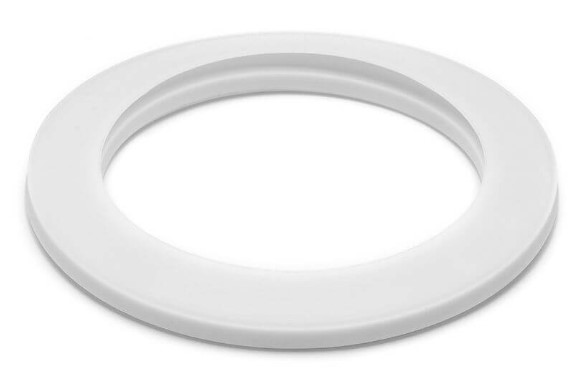
PTFE envelope gaskets, also commonly referred to as fluoropolymer-coated gaskets, are composite sealing materials specifically designed for harsh industrial environments. These gaskets adopt a unique dual-layer structure, with the outer layer made of a thin PTFE coating and the inner layer embedded with asbestos rubber sheets, non-asbestos rubber sheets, graphite composite sheets, or other elastic sealing materials as the core. The design concept of this composite structure is very clear: it uses the excellent chemical resistance of PTFE to protect the internal core while relying on the core to provide good mechanical strength and elastic recovery ability, thereby forming a composite gasket that is both corrosion-resistant and provides reliable sealing performance.
PTFE itself has extremely strong chemical inertness, capable of resisting almost all strong acids, strong bases, and strong oxidizers. However, pure PTFE has a significant drawback: it has a high tendency for cold flow and can undergo plastic deformation under long-term compression, leading to a decline in sealing performance. By using PTFE as a coating layer with an elastic core as support, this PTFE envelope gasket successfully addresses the mechanical strength insufficiency of pure PTFE gaskets while retaining its excellent corrosion resistance.
PTFE envelope gaskets are mainly divided into three types according to manufacturing process and structural characteristics, each with specific application scenarios and size ranges.
- V-Type (Cut Type): This type uses a cutting process to slice the PTFE sheet from the outer to the inner wall, forming an open coating structure. V-type gaskets are considered economical products, mainly suitable for low-pressure operating conditions. In terms of size specifications, V-type is typically applicable for pipeline systems with nominal diameters DN15 to DN200. Due to its relatively simple manufacturing process and lower cost, it is an ideal choice for occasions with limited budget and low-pressure requirements.
- L-Type (Machined/Square Type): L-type gaskets are machined using mechanical turning processes, forming a square-section coated structure from PTFE sheets through precise mechanical processing. This type is suitable for medium- and high-pressure conditions, offering better structural integrity and sealing reliability. L-type is suitable for applications with nominal diameters not exceeding DN500, performing excellently in medium and small-diameter pipeline systems. For nominal diameters less than or equal to DN500, L-type is generally recommended over V-type to achieve better sealing performance and safety margin.
- U-Type (Folded/Wrap-Around Type): U-type gaskets are manufactured using a folding and edge-wrapping process, where PTFE tape is wrapped around the core and then fixed by heat bonding. This structure is suitable for large-diameter pipeline systems, typically for nominal diameters DN200 and above, with a maximum coverage of DN5000 or larger. For flange connections with nominal diameters greater than or equal to DN350, U-type is the standard choice. Its folded structure provides better structural stability and uniform sealing in large-diameter applications.
In practical engineering applications, selecting a gasket type requires comprehensive consideration of pipeline diameter, operating pressure, medium characteristics, and economic factors. Generally, for medium and small diameters (below DN500) with medium- to high-pressure systems, L-type machined gaskets are preferred; for large diameters (DN350 and above), U-type folded gaskets must be used; for low-pressure, small-diameter (below DN200) secondary applications, the more cost-effective V-type cut gaskets can be considered.
PTFE envelope gaskets have a wide temperature adaptation range, and standard products typically maintain stable sealing performance within -100°C to +260°C. This temperature range covers most industrial scenarios, from cryogenic conditions to high-temperature steam systems. However, it should be noted that the actual upper temperature limit of the gasket largely depends on the core material, as different core materials have significantly different temperature resistance.
In terms of pressure resistance, PTFE envelope gaskets are suitable for pressure ranges of 0.6 to 2.5 MPa, with some reinforced products reaching up to 5.0 MPa. This pressure rating is suitable for most medium- and low-pressure industrial pipeline systems. For extreme high-pressure conditions, metal-jacketed gaskets or other high-pressure sealing solutions may need to be considered.
Chemical compatibility is the most prominent advantage of this type of gasket. The PTFE coating can resist almost all chemical media except molten alkali metals, elemental fluorine, and nitrogen trifluoride, including various concentrations of strong acids (such as sulfuric acid, hydrochloric acid, nitric acid, hydrofluoric acid), strong bases (such as sodium hydroxide, potassium hydroxide), strong oxidizers (such as hydrogen peroxide, potassium permanganate), chlorine, oxygen, and various organic solvents. This near-universal chemical resistance makes the gasket the preferred sealing solution for handling corrosive media in the chemical industry.
PTFE envelope gaskets are widely used in industrial fields due to several unique performance advantages:
- Excellent corrosion resistance: This is the core competitive advantage of the gasket. PTFE material has extremely high chemical stability and will not dissolve or swell in any known chemical. In chemical production, many media are highly corrosive, and ordinary rubber or metal gaskets can be damaged in a short time. PTFE envelope gaskets can operate stably for long periods, significantly extending maintenance intervals and reducing leakage risks.
- Outstanding anti-contamination properties: Due to PTFE’s very low surface energy, substances do not easily adhere, and it does not react chemically with media, releasing no impurities. This makes it an ideal choice for industries with extremely high cleanliness requirements, such as food, pharmaceuticals, and biotechnology. In these industries, even minor contamination can lead to product rejection or serious safety incidents, making this high-purity sealing material essential.
- Good compression and elastic recovery: The internal elastic core provides good compressibility and elastic recovery. When flange bolts apply pressure, the gasket can undergo appropriate plastic deformation to fill microscopic irregularities on the flange sealing surface. When system temperature or pressure fluctuations cause flange spacing changes, the core’s elasticity compensates for these changes, maintaining stable sealing stress. This adaptive ability exceeds that of pure PTFE or rigid metal gaskets.
- Low friction coefficient and ease of maintenance: PTFE has one of the lowest friction coefficients among solid materials, making it easy to install and remove without sticking to flange surfaces, facilitating inspection and maintenance. For equipment that requires frequent disassembly, this feature improves maintenance efficiency and reduces labor intensity.
- Structural limitations: It is important to note that the PTFE coating is usually only 0.5 to 1 mm thick. This thin protective layer is easily scratched or torn during installation. Once the coating is damaged, corrosive media can penetrate the core, causing rapid corrosion failure. Therefore, these gaskets are unsuitable for frequent disassembly or narrow installation spaces. For critical sealing locations, regular replacement or alternative solutions such as modified PTFE gaskets or expanded PTFE gaskets with higher mechanical durability are recommended.
PTFE envelope gaskets have extremely broad applications, covering almost all industrial fields involving corrosive media:
- Chemical and petrochemical industry: The primary market for these gaskets. They are standard sealing configurations in production equipment for sulfuric acid, hydrochloric acid, nitric acid, phosphoric acid, in chlor-alkali electrolysis cells and pipelines, and in organic synthesis reactors and distillation columns. The media handled in these scenarios are often highly corrosive, typically under high-temperature and high-pressure conditions, placing stringent demands on the comprehensive performance of sealing materials.
- Pharmaceutical industry: Drug production requires strict cleanliness, and no sealing material may release harmful substances into the product. PTFE envelope gaskets are both corrosion-resistant and compliant with FDA and other regulatory standards, widely used in raw material synthesis, formulation, and fermentation pipelines and equipment.
- Food and beverage processing: In dairy, beer, beverages, edible oils, and other food processing, equipment must meet sanitary standards. PTFE envelope gaskets are non-toxic, tasteless, do not contaminate food, and are easy to clean and disinfect. They are widely used for flanges on filling machines, sterilizers, storage tanks, and pipelines.
- Metallurgy and non-ferrous smelting: Wet metallurgy and electrolytic refining processes often involve strong acids and bases. In copper, zinc, nickel, and other non-ferrous metal electrolytic refining, corrosive electrolytes require PTFE envelope gaskets to effectively seal electrolytic cells and pipelines, preventing leaks that could cause environmental pollution and production losses.
- Environmental protection and water treatment: In wastewater treatment, exhaust gas treatment, and flue gas desulfurization/denitrification facilities, the media often contain corrosive components. PTFE envelope gaskets are used for pipelines, valves, and pump connections to ensure long-term stable operation and prevent harmful leaks.
- Energy and power: In nuclear power plants, thermal power plants, and new energy battery production, PTFE envelope gaskets are used in cooling water systems, chemical water treatment systems, and exhaust treatment systems. Particularly in the nuclear industry, where purity and reliability requirements are extremely high, these gaskets meet strict nuclear-grade standards.
- Specific Equipment Applications: PTFE envelope gaskets can be used in various static sealing scenarios, including pipeline flanges, valve covers, pump seals, pressure vessel manholes, heat exchanger tube sheets, condenser end caps, generator cooling systems, air compressor piping, refrigeration connections, and more. Any medium- or low-pressure flange connection involving corrosive media or high cleanliness requirements can consider using these gaskets.
Correct selection and use of PTFE envelope gaskets is crucial for ensuring the reliability of the sealing system.
- Operating condition matching principle: First, accurately evaluate the chemical nature, temperature, and pressure parameters of the working medium. If the medium is highly corrosive and the temperature and pressure are within the gasket’s applicable range, PTFE envelope gaskets are a suitable choice. However, if the working pressure exceeds 5.0 MPa or the temperature exceeds 260°C, other types of sealing solutions should be considered, such as metal-jacketed gaskets or metal ring gaskets. For vacuum systems, since PTFE has certain permeability, specially designed vacuum-grade gaskets may be required.
- Size specification determination: Choose the appropriate type and size according to the nominal diameter and pressure rating of the flange. L-type machined gaskets are preferred for DN500 or below, U-type folded gaskets must be used for DN350 and above. The inner diameter of the gasket should match the pipe inner diameter, and the outer diameter should match the flange sealing surface. Thickness is usually 3 mm or selected according to the standard.
- Installation key points: Before installation, inspect the flange sealing surface to ensure it is flat, free of scratches or dents, and meets roughness requirements. Clean off rust, residual old gaskets, and other debris. During installation, handle gently and avoid contact of sharp tools with the PTFE coating. Bolt tightening should be done stepwise in a diagonal sequence to prevent uneven force causing gasket deformation. Tightening torque should be controlled within the recommended range: too high may crush the core, too low may prevent effective sealing.
- Regular inspection and replacement: Because the PTFE coating is thin, long-term operation may result in aging, cracking, or wear. It is recommended to establish a regular inspection system and check the gasket during equipment maintenance. For critical sealing locations, even if the gasket appears intact, it should be replaced periodically according to a preventive maintenance plan to avoid leakage incidents caused by sudden gasket failure.
- Alternative solutions: In cases of frequent disassembly, limited installation space, or high mechanical damage risk, consider using modified PTFE gaskets (reinforced with glass fiber, graphite, or molybdenum disulfide to improve strength and wear resistance) or expanded PTFE gaskets (with better flexibility and creep resistance). Although these materials are more costly, they offer longer service life and higher reliability under specific conditions.
PTFE envelope gaskets, as a mature industrial sealing product, cleverly combine the chemical inertness of PTFE with the mechanical performance of an elastic core, providing an economical and reliable sealing solution for handling corrosive media. Their broad chemical compatibility, excellent anti-contamination properties, and stable sealing performance have led to widespread use across chemical, pharmaceutical, food, metallurgy, and many other industries.
However, these gaskets are not universal. Their thin coating makes them better suited for relatively stable operating conditions, requiring careful protection during installation and maintenance. Engineers should fully understand their performance characteristics and limitations, select the appropriate type and material based on specific conditions, and strictly follow installation guidelines to fully leverage their advantages, ensuring safe and stable operation of industrial equipment.
With advances in materials technology, new sealing materials such as modified PTFE and expanded PTFE continue to emerge. However, traditional PTFE envelope gaskets, with their mature manufacturing process and moderate cost, will continue to play an important role in medium- and low-pressure corrosion-resistant sealing applications.
