
In modern industrial production, sealing technology plays a critical role in ensuring the safe and reliable operation of mechanical equipment. As two widely used sealing materials, graphite packing and polytetrafluoroethylene (PTFE) packing each offer unique performance advantages and are suitable for different operating environments. This article provides an in-depth analysis of the differences between these two types of valve packing from the perspectives of material composition, physical properties, chemical stability, and application scenarios, offering practical guidance for engineering material selection.
The performance differences between sealing materials originate from their fundamental composition and processing methods. To fully understand why graphite packing and PTFE packing exhibit distinct characteristics, it is necessary to examine their manufacturing origins.
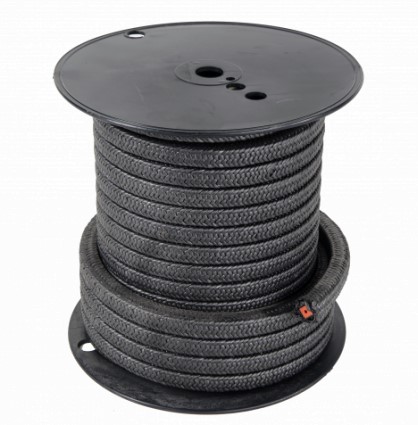
Graphite packing is primarily made from high-purity graphite fibers woven into packing through a three-dimensional braiding process. Graphite is a naturally occurring form of carbon with a typical layered crystalline structure. During production, multiple graphite filaments are first heated and twisted into yarns, which are then braided into packing structures to significantly enhance tensile strength and durability.
The preparation of flexible graphite (also known as expanded graphite) is more complex. Manufacturers treat graphite sheets through oxidation using sulfuric and nitric acids, followed by high-temperature heating. This process weakens the bonding forces between carbon layers, allowing them to expand and form a worm-like porous structure. This unique structure gives flexible graphite excellent flexibility and compression resilience.
It is worth noting that graphite packing undergoes complex chemical changes during solid-phase carbonization. When the temperature reaches approximately 2200°C, nearly all non-carbon elements, mainly nitrogen, are removed from the carbon fibers, resulting in graphite fibers with carbon content close to 100%. This process leaves about 6–7% porosity, reaching the peak porosity level during graphitization, after which the material gradually densifies at high temperatures. Generally, industrial-grade graphite packing contains more than 95% carbon.
To further enhance sealing performance, manufacturers often coat the surface of graphite packing with lubricants such as aramid or PTFE to fill gaps between woven fibers, reduce friction, and improve sealing tightness.
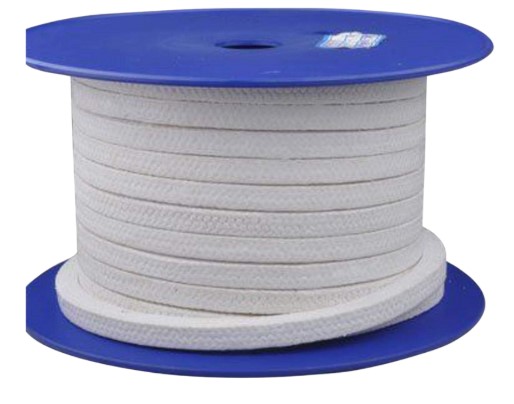
PTFE packing is made from synthetic polymer materials. PTFE is a fluoropolymer of tetrafluoroethylene, commonly known as Teflon in commercial applications. The carbon–fluorine bond energy in its molecular structure can reach 485 kJ/mol, making it one of the strongest organic chemical bonds known. Meanwhile, PTFE has an extremely low surface energy of approximately 18.5 mN/m, giving the material outstanding non-adhesive properties and making it an ideal “non-stick” coating material.
The manufacturing process of PTFE packing varies. It can be produced from 100% pure PTFE dispersion resin formed into films and then twisted and braided into packing yarns. PTFE can also be impregnated with lubricants to enhance performance or processed by coating conventional fibers with PTFE to create composite structures. Depending on formulations and processes, a wide range of product variants has been developed, including white PTFE packing, black PTFE packing, oil-impregnated types, oil-free types, and aramid-crosswoven fiber types.
Material composition determines physical properties. The layered crystalline structure of graphite and the linear polymer chains of PTFE impart distinctly different thermal, mechanical, and tribological characteristics.
Thermal conductivity is a key indicator of a sealing material’s heat dissipation capability. Graphite packing exhibits thermal conductivity values of approximately 50–120 W/(m·K), which is relatively high among sealing materials. This enables efficient conduction of friction-generated heat and prevents localized overheating, making graphite packing especially suitable for high-speed rotating equipment requiring dynamic sealing.
In contrast, PTFE has relatively low thermal conductivity and behaves as a thermal insulating material. More importantly, the two materials differ significantly in temperature resistance. Graphite packing can withstand long-term exposure to temperatures up to 500°C in oxidizing environments and even higher temperatures in reducing atmospheres. PTFE, however, begins thermal decomposition above 260°C, releasing toxic hydrogen fluoride gas. Therefore, its long-term service temperature is generally limited to around 250°C, with short-term peaks not exceeding 260°C.
The friction coefficient directly affects wear rate and power consumption. Graphite packing maintains a stable friction coefficient between 0.1 and 0.3 and provides excellent self-lubricating performance, making it suitable for both wet and dry operating conditions. PTFE exhibits an even lower friction coefficient, typically between 0.05 and 0.1, making it one of the lowest-friction solid materials available and earning it the reputation of the “king of plastics.”
However, an extremely low friction coefficient is not always advantageous. Under high-pressure conditions, PTFE is prone to cold flow deformation, a phenomenon in which the material slowly undergoes plastic deformation under continuous stress, eventually leading to sealing failure. Although graphite packing has a slightly higher friction coefficient, its structural strength and creep resistance are superior to those of pure PTFE materials.
Graphite packing features a porous structure that provides excellent compressibility and resilience, allowing it to adapt to microscopic surface irregularities of sealing faces. Reinforcement using materials such as carbon fiber, copper wire, 304 stainless steel wire, 316L stainless steel wire, or brass-nickel alloy wire can significantly improve tensile strength and pressure resistance. Reinforced graphite packing is particularly suitable for extreme high-temperature and high-pressure conditions.
PTFE packing is relatively soft in texture. Pure PTFE packing has good flexibility and can match well with shafts and stuffing boxes. However, pure PTFE has relatively low mechanical strength and wear resistance compared to graphite materials. To address this weakness, manufacturers have developed various composite structures. For example, aramid-crosswoven black PTFE packing uses high-strength aramid fibers to significantly improve wear resistance and tear strength. Oil-impregnated PTFE packing incorporates graphite and lubricants to maintain chemical inertness while improving thermal conductivity and wear resistance.
Chemical resistance is one of the most important selection criteria for sealing materials.
PTFE exhibits absolute inertness toward strong acids, strong alkalis, and organic solvents due to its highly fluorinated molecular structure. It can resist corrosion from aqua regia (a mixture of concentrated nitric and hydrochloric acids) and even boiling aqua regia without chemical degradation. Except for molten alkali metals and elemental fluorine, PTFE resists nearly all chemical corrosion, making it the preferred sealing material in the chemical industry for handling highly corrosive media.
Graphite packing has relatively limited chemical resistance. Although it can be used to seal hot water, superheated steam, heat transfer fluids, ammonia solutions, hydrocarbons, and low-temperature liquids, it may suffer interlayer corrosion in strongly oxidizing media. Strong oxidizers such as concentrated sulfuric acid, concentrated nitric acid, and chromic acid can attack graphite’s layered structure, causing material powdering and failure. Therefore, graphite packing should be selected cautiously when dealing with strong oxidizing media, or oxidation-resistant treated graphite types should be used.
From a hygiene and cleanliness perspective, PTFE is white in color and does not cause color migration, making it particularly suitable for food processing, pharmaceutical, paper, and chemical fiber industries. Pure PTFE packing contains no additives and can be used in food-grade and medical equipment sealing applications. Other fiber materials treated with PTFE impregnation can also effectively prevent color transfer and product contamination. Graphite packing, due to its carbon content, may be restricted in high-purity environments because of its black appearance and possible micro-particle shedding.
Theoretical performance must ultimately be realized through specific products. In response to complex operating conditions, single-material sealing solutions are often insufficient. Therefore, both graphite packing and PTFE packing have evolved into diversified product families through reinforcement, weaving process optimization, and impregnation treatments.
PTFE packing has developed a comprehensive product spectrum to meet various operational requirements.
- White PTFE packing: Made from pure PTFE fibers woven without PTFE emulsion or lubricant treatment. It offers excellent corrosion resistance and self-lubricating properties, making it suitable for chemical, food, pharmaceutical, paper, chemical fiber, and fine chemical industries where contamination is strictly prohibited. It can be used with almost all chemical media except soluble alkali metals and free fluoride ions.
- Black PTFE packing: Contains graphite particles to improve thermal conductivity and wear resistance while maintaining PTFE’s chemical inertness. Oil-free black PTFE packing is woven from PTFE yarns containing graphite particles, while oil-impregnated black PTFE packing adds anti-corrosion lubricants, providing higher tear strength and thermal conductivity.
- Aramid-crosswoven series: White PTFE aramid-crosswoven packing and black PTFE aramid-crosswoven packing are produced by blending high-strength aramid fibers with PTFE fibers using special weaving techniques. Aramid fibers, whose strength is five to six times that of steel wire, significantly enhance wear resistance and extrusion resistance, making this type suitable for high peripheral speeds and relatively high medium pressures in dynamic sealing systems.
- Impregnated packing types: Silicone oil-impregnated white PTFE packing and rubber-core PTFE packing are treated with special lubricants. These products can maintain stable volume under low compression pressure for long-term operation. Their low friction coefficient helps prevent heat accumulation and shaft surface overheating even at high rotational speeds, making them suitable for highly concentrated, strongly corrosive, and oxidizing chemical processes.
- Split-yarn PTFE packing: Made from multi-strand PTFE yarns that are sintered and fully stretched, then impregnated and re-impregnated during weaving. This structure provides excellent flexibility, dimensional stability, compression resistance, and structural strength, making it one of the best-performing industrial packing materials.
- PTFE packing series mainly uses polytetrafluoroethylene as the primary material and provides excellent chemical stability, corrosion resistance, sealing performance, non-stick lubricity, and aging resistance. It can operate continuously within a temperature range of +250°C to −180°C and is primarily used in hygienic, highly corrosive, high-speed, and high-wear environments where contamination is not allowed.
Graphite packing also features a diversified product system.
- Flexible graphite packing: This packing is carefully braided from graphite as the main material. It offers good self-lubrication, excellent thermal conductivity, low friction coefficient, strong versatility, soft texture, and high strength while protecting the shaft surface.
- Reinforced series: Depending on operating conditions, reinforcement materials such as carbon fiber, 304 stainless steel wire, 316L stainless steel wire, copper wire, or brass-nickel alloy wire may be used. Metal-reinforced graphite packing significantly improves compressive strength and high-temperature resistance. Carbon fiber-reinforced graphite packing provides excellent strengthening effects while remaining lightweight. Carbon fiber-metal hybrid reinforced graphite packing combines the advantages of both reinforcement materials.
- Special-purpose products: Pre-oxidized fiber reinforced graphite packing uses oxidized polyacrylonitrile fiber as reinforcement, offering superior high-temperature ablation resistance. Impregnated graphite packing improves sealing performance and chemical stability through PTFE or lubricant impregnation.
- Graphite packing is mainly suitable for high-temperature and high-pressure dynamic sealing. Except for a few strong oxidizers, it can be used to seal hot water, superheated steam, heat transfer fluids, ammonia solutions, hydrocarbons, and low-temperature liquids. It is widely used in valves, pumps, and reactor sealing under high-temperature, high-pressure, and corrosive media conditions.
The diversity of product specifications originates from the complexity of application scenarios. From high-temperature and high-pressure valves in refineries to hygienic pumps in food production lines, different industries impose completely different technical requirements on sealing materials.
Based on its resistance to high temperature, high pressure, and excellent thermal conductivity, graphite packing is mainly used in the following fields:
- Petrochemical industry: Sealing of high-temperature and high-pressure valves in hydrogenation units, catalytic cracking units, and reforming units in refineries. These conditions often involve temperatures above 500°C and pressures exceeding 10 MPa, with media potentially containing hydrogen sulfide and other corrosive components.
- Power generation industry: Main pump sealing in nuclear power plants, boiler feedwater pump sealing in thermal power plants, and high-temperature steam valve sealing. Nuclear applications demand extremely high reliability and radiation resistance, which high-purity graphite packing can provide.
- Chemical equipment manufacturing: Sealing of reactor dynamic components, high-temperature heat exchanger systems, and high-temperature high-pressure pipeline flanges. Graphite’s thermal conductivity helps dissipate reaction heat and prevents local overheating damage.
- Metallurgy and mining: Sealing for molten metal processing equipment and slurry pumps. Although graphite is not suitable for molten alkali metals, it performs well when handling other high-temperature media.
- Marine engineering: Sealing of marine diesel exhaust systems and seawater pumps (appropriate corrosion-resistant grades should be selected).
Thanks to its chemical inertness and non-stick properties, PTFE packing plays an important role in the following industries:
- Food and beverage industry: Sealing of food machinery, beverage filling equipment, and edible oil transport pumps. PTFE complies with FDA food-contact material standards, does not contaminate products, and is easy to clean, meeting hygienic requirements.
- Pharmaceutical industry: Sealing of reactor equipment in API production, pharmaceutical manufacturing equipment, and sterile production line valves. PTFE does not adsorb pharmaceutical components and can be easily sterilized, complying with GMP standards.
- Fine chemical industry: Sealing systems for high-purity chemical transport and highly corrosive media such as hydrofluoric acid and concentrated sulfuric acid. PTFE’s chemical inertness ensures product purity and equipment safety.
- Paper and chemical fiber industry: Sealing of pulp pumps and fiber spinning equipment. PTFE’s non-stick property prevents fiber adhesion and reduces cleaning frequency.
- Electronics and electrical industry: Sealing in high-purity chemical transport and semiconductor manufacturing equipment. PTFE is electrically non-conductive and reduces shaft wear, making it suitable for precision electronic equipment.
How can engineers make scientific material selection decisions in practical applications?
The selection of sealing materials should be based on a systematic evaluation framework considering the following factors:
- Medium characteristics: Determine the pH value of the medium, evaluate oxidation strength, and prioritize PTFE or oxidation-resistant graphite packing for strongly oxidizing media. Confirm whether the medium contains organic solvents and whether it is food-grade or pharmaceutical-grade.
- Temperature conditions: Distinguish between instantaneous peak temperature and continuous operating temperature. If the long-term temperature exceeds 260°C, pure PTFE should be excluded. If the temperature is between 260°C and 500°C, graphite packing is generally more suitable. For extreme temperatures above 500°C, special ceramic fiber or metal sealing materials may be required.
- Mechanical load analysis: Evaluate axial pressure and circumferential shear stress. High-pressure conditions above 20 MPa require reinforced graphite packing or high-strength PTFE composite materials. High-speed rotation environments above 20 m/s require attention to thermal conductivity and wear resistance.
- Environmental conditions: For alternating wet and dry environments, consider water absorption expansion and dimensional stability. PTFE has nearly zero water absorption and excellent dimensional stability, whereas ordinary graphite packing may swell due to pore absorption, requiring waterproof treated types.
High-temperature, high-pressure, and highly corrosive composite conditions: Single-material solutions are often insufficient. Composite sealing structures may be adopted, such as using graphite packing on the outer layer to withstand high temperature and pressure while using PTFE packing on the inner layer for corrosion resistance. Composite materials such as carbon fiber reinforced PTFE packing or metal wire reinforced graphite packing may also be used.
- Cryogenic conditions: PTFE retains flexibility at temperatures as low as −180°C, making it ideal for sealing cryogenic liquids such as liquid oxygen, nitrogen, and hydrogen. Graphite packing may leak at low temperatures due to pore contraction and therefore requires special densification treatment.
- Radiation environments: Nuclear industry applications should use high-purity, low-halogen graphite packing to avoid harmful gas generation under irradiation. Radiation resistance should also be considered, as graphite generally performs better than organic polymer materials.
Graphite packing and PTFE packing are two cornerstone materials in industrial sealing technology, each offering irreplaceable advantages. Graphite packing is preferred in energy, chemical, and metallurgical industries due to its excellent high-temperature resistance, high-pressure load capacity, and thermal conductivity. PTFE packing dominates in food, pharmaceutical, fine chemical, and electronic applications due to its outstanding chemical inertness and hygienic safety.
Successful sealing design does not pursue the extreme performance of a single material but requires accurate understanding of operating conditions and scientific evaluation of medium properties, temperature and pressure loads, and mechanical stresses. At the same time, proper installation and maintenance are equally important for ensuring long-term reliable operation of sealing systems.
