
Polytetrafluoroethylene packing, commonly known as PTFE packing, is a high-performance sealing material manufactured primarily from polytetrafluoroethylene. To fully understand the importance of PTFE packing, it is essential first to examine its base material, polytetrafluoroethylene itself. Polytetrafluoroethylene (PTFE), often referred to as the King of Plastics, is also widely known under trade names such as Teflon, PTFE, and other regional variants. It is a high-molecular-weight polymer produced by the polymerization of tetrafluoroethylene, with a chemical structure consisting of repeating –CF₂–CF₂– units. PTFE is recognized as one of the most corrosion-resistant materials currently available, capable of long-term service in nearly all chemical environments. Its introduction has addressed numerous critical challenges in industries such as chemical processing, petroleum, and pharmaceuticals. As an important category of PTFE products, PTFE packing is typically braided from soft, filament-like PTFE fibers. Its cross-section is commonly square, rectangular, or round, and it is installed as a continuous strand within a stuffing box or sealing chamber to prevent fluid leakage. Despite its simple appearance, PTFE packing embodies significant engineering value and plays a vital role in modern sealing systems.
- Exceptional Chemical Stability: One of the most outstanding characteristics of PTFE packing is its exceptional chemical stability. It can operate continuously within a temperature range of approximately –180°C to +250°C, and it is resistant to almost all chemical substances except molten alkali metals such as sodium and liquid fluorine. Even when boiled in aqua regia, PTFE remains unchanged. This makes PTFE packing an ideal sealing solution for highly corrosive media, including strong acids, strong alkalis, and organic solvents.
- Wide Operating Temperature Range: PTFE packing maintains stable performance over an extremely wide temperature range, typically from –190°C to +260°C. Whether used in extremely cold environments or in high-temperature chemical reactors, it provides reliable sealing performance without degradation.
- Excellent Physical Properties: PTFE packing exhibits outstanding physical characteristics, including low friction, non-stick behavior, excellent electrical insulation, and strong resistance to aging. Its extremely low coefficient of friction allows it to perform well in both dynamic and static sealing applications while minimizing wear on shafts and valve stems. The superior electrical insulation properties also make PTFE packing suitable for sealing applications in electrical and electronic equipment.
- Safety and Environmental Characteristics: PTFE is non-toxic, clean, and chemically inert, making it particularly suitable for industries that require high purity, such as food processing, pharmaceuticals, and semiconductors. Although ammonium perfluorooctanoate (PFOA), once used in PTFE production, has raised health concerns, finished PTFE materials are considered safe for industrial and commercial use.
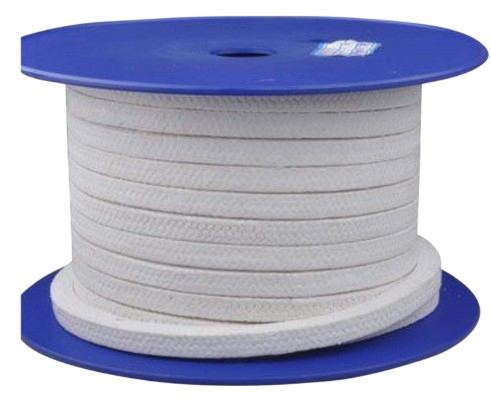
- Importance of Braiding Technology: PTFE packing should be produced on multi-carrier, multi-track braiding machines. A higher number of carriers results in tighter interlacing of fibers, which significantly improves durability. Packing produced on four-track machines typically has a smoother and more uniform surface than that produced on three-track machines, leading to improved sealing efficiency and reduced gland compression requirements. However, for small-size packing, four-track machines may not always be the optimal choice, and manufacturers must adjust production methods based on specific requirements.
- Role of Braiding Density: Braiding density is a critical factor affecting the performance of PTFE packing. Braiding is a process that combines engineering precision with craftsmanship, and density is often difficult to quantify numerically. In most applications, tightly and uniformly braided PTFE packing provides superior performance. Dense braiding improves resistance to wear and extrusion, minimizes deformation at elevated temperatures, reduces the need for frequent adjustment, and effectively controls leakage.
- Dimensional Selection Considerations: Proper size selection is another key factor influencing sealing performance. The Fluid Sealing Association generally allows slight dimensional deviation, but professional practice recommends avoiding oversized packing. PTFE packing performs best when installed at or slightly below the nominal size, ensuring proper fit even under special conditions and minimizing downtime and installation failure. Manufacturers commonly use wheel-pressure braiding and pre-formed packing rings to meet dimensional requirements accurately.
- Installation and Maintenance Guidelines: During maintenance or repacking, users should not add additional lubricants to PTFE packing. Extra lubrication increases packing weight, reduces flexibility, compromises impact resistance, and ultimately increases maintenance costs while diminishing the inherent advantages of PTFE material.
- Pure PTFE Packing: Pure PTFE packing is braided from 100% PTFE fibers and offers exceptional chemical inertness and corrosion resistance. It reacts with virtually no media, has a low friction coefficient, and does not contaminate process fluids. It is ideal for strong acids, strong alkalis, and high-purity applications. While flexible and easy to install, its extrusion resistance and wear resistance are relatively limited, making it suitable for low- to medium-pressure and low-speed equipment.
- Oil-Impregnated PTFE Packing: Oil-impregnated PTFE packing incorporates lubricants into PTFE fibers to reduce operating friction and startup torque. This minimizes shaft or stem wear and improves sealing stability. It generates less heat during operation and is well suited for continuous-duty applications, such as pumps handling water, steam, and general chemical media.
- Graphite-Enhanced PTFE Packing: By incorporating graphite into PTFE, this type of packing significantly improves thermal conductivity and wear resistance. It maintains stable sealing performance under higher temperatures and rotational speeds, with a consistent friction coefficient that prevents shaft scoring or packing burn-out. It is commonly used in pumps and valves handling hot water, steam, and heat-transfer fluids.
- Aramid-Reinforced PTFE Packing: Aramid-reinforced PTFE packing uses high-strength aramid fibers for full or corner reinforcement. While retaining PTFE’s corrosion resistance, it greatly enhances extrusion resistance, tensile strength, and abrasion resistance. This type is ideal for high-pressure, high-load applications and for media containing solids or slurry, such as mining, pulp and paper, and wastewater systems.
- Carbon Fiber-Reinforced PTFE Packing: Carbon fiber-reinforced PTFE packing combines PTFE with carbon fibers to achieve excellent mechanical strength, high-temperature resistance, and effective heat dissipation. It reduces frictional heat buildup and is suitable for demanding high-temperature, high-pressure, and continuous-operation conditions commonly found in chemical, petroleum, refining, and energy industries.
- Expanded PTFE (ePTFE) Packing: Expanded PTFE packing features a porous structure with excellent softness and resilience. It conforms easily to shaft and stuffing box surfaces, providing reliable sealing with minimal shaft wear. Its strong adaptability makes it suitable for valve packing, low-speed equipment, and sealing retrofits for aging systems.
- Composite PTFE Packing: Composite PTFE packing combines PTFE with materials such as graphite, aramid, or carbon fiber to achieve a balanced combination of corrosion resistance, mechanical strength, and wear resistance. It offers broad applicability and can be tailored to specific operating conditions, making it widely used in chemical, power generation, metallurgy, and paper industries.
When selecting PTFE packing, the following parameters should be carefully considered:
- Density: Excessive density reduces elasticity, while insufficient density compromises wear resistance.
- Thickness: Selected according to stuffing box dimensions.
- Length and Width: Determined by installation requirements.
- Color: Should be specified if special identification is required.
- Strength, Elongation, and Capillary Action: Selected based on technical specifications and operating needs.
It is recommended to inform suppliers of the intended application in advance so that suitable products can be recommended. Incoming inspection can be conducted using the above criteria to verify product quality.
PTFE packing is used across nearly all industries requiring high-performance sealing solutions.
- Chemical and Petroleum Industries: PTFE packing is widely used in pipelines, vessels, pumps, and valves handling corrosive media. Its resistance to acids, alkalis, solvents, and chemicals ensures reliable sealing in harsh environments.
- Pharmaceutical and Food Industries: Due to its cleanliness and non-toxicity, PTFE packing is ideal for pharmaceutical and food-processing equipment, ensuring compliance with strict hygiene and purity standards.
- Mechanical and Electrical Industries: PTFE packing is commonly used in machinery, machine tools, electrical equipment, and power tools. Its excellent electrical insulation properties make it suitable for high-frequency communication and electronic devices.
- Transportation Sector: In automotive manufacturing, rail systems, aerospace, and marine applications, PTFE packing provides durable sealing performance. Its resistance to aging and environmental exposure allows it to perform reliably under demanding operating conditions.
As a key application of the King of Plastics, PTFE packing has become an indispensable material in modern industrial sealing due to its exceptional chemical stability, wide temperature tolerance, excellent physical properties, and reliable safety characteristics. A thorough understanding of its performance features, proper selection methods, and correct installation and maintenance practices is essential to fully realize its advantages.
When selecting PTFE packing, users should carefully evaluate operating conditions, consult professional manufacturers, and choose appropriate specifications and quality grades to ensure long-term, stable sealing performance. Keeping pace with technological advancements and adopting new materials and processes can further enhance equipment reliability and economic efficiency.