
In modern industrial production, the selection of sealing materials directly determines equipment safety, operational stability, and system efficiency. With increasingly strict requirements for environmental protection and operational safety, traditional asbestos-based gaskets have been gradually replaced by safer, high-performance alternatives. Among them, CNAF gaskets (Compressed Non-Asbestos Fiber gaskets) have become a widely adopted sealing solution in industrial pipelines, mechanical systems, and demanding operating environments due to their excellent thermal resistance, chemical resistance, and superior compressibility and resilience. This article provides a comprehensive overview of CNAF gaskets, including their structure, working principles, performance characteristics, applications, and selection considerations, helping industries understand their advantages and apply them effectively in real-world conditions.
A CNAF gasket, short for Compressed Non-Asbestos Fiber gasket, is a sealing component manufactured by compressing multiple layers of heat-treated fiber materials into a dense, stable structure. It was first introduced in industrial applications in the 1950s as a replacement for traditional asbestos gaskets and remains widely used across mechanical and industrial systems today.
The primary function of a CNAF gasket is to create a reliable seal between two mating surfaces, preventing leakage of fluids or gases. It is typically installed between flange faces and compressed using bolted connections to form an effective sealing barrier.
CNAF gaskets are made from a composite of organic and synthetic fibers, including glass fiber, ceramic fiber, aramid fiber, and other polymer-based materials. These fibers are bonded together using elastomeric binders such as nitrile rubber (NBR) or ethylene propylene diene monomer (EPDM).
During manufacturing, reinforcing fillers are added to enhance mechanical strength and chemical resistance. This composite structure enables CNAF gaskets to combine the strength of fiber materials with the elasticity of rubber, ensuring stable sealing performance under a wide range of operating conditions.
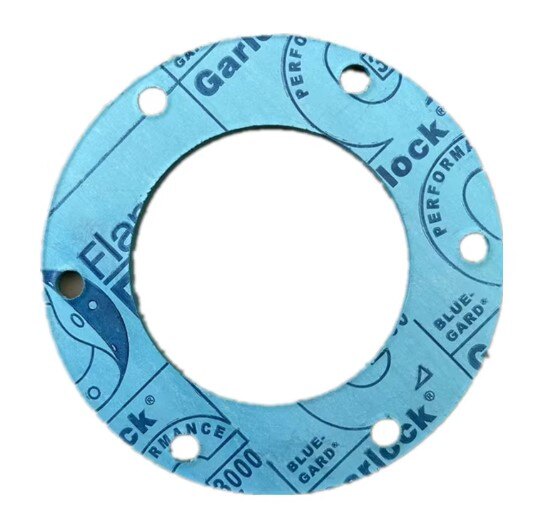
Unlike metal gaskets that rely primarily on material rigidity, CNAF gaskets operate through the synergistic behavior of composite materials. Under compression, the gasket deforms in a controlled manner, filling microscopic surface irregularities on flange faces. This ensures a tight and reliable seal under varying operating conditions.
The working principle of CNAF gaskets is based on compression sealing. During installation, the gasket is placed between two flange surfaces, and bolting force is applied to compress it. Under pressure, the gasket material deforms and fills surface imperfections, creating an interference fit that prevents leakage.
When the system is in operation, internal pressure acts on the gasket surface. Since the gasket has already been pre-compressed, the internal pressure is distributed evenly across the sealing interface, further improving sealing performance. This self-tightening pressure effect enhances sealing reliability during operation.
The composite structure of CNAF gaskets combines fiber reinforcement with elastomeric bonding materials. The fiber component provides structural strength and thermal resistance, while the rubber binder enhances flexibility and sealing adaptability.
Compared with single-material gaskets, this composite design performs better under corrosive or demanding operating conditions. The synergy between rigid fibers and elastic binders ensures that the gasket maintains sealing integrity even under fluctuating pressure environments.
CNAF gaskets are widely used in industries such as petrochemical, power generation, and pharmaceuticals due to their balanced performance profile. Unlike pure rubber gaskets, they are not limited by temperature constraints, and unlike metal gaskets, they offer excellent elasticity and sealing compensation ability.
CNAF gaskets offer a broad operating temperature range. Depending on fiber composition and formulation, their typical temperature range is approximately -200°C to 400°C, with specialized formulations capable of withstanding -100°C to 650°C.
This thermal stability allows them to perform reliably in both cryogenic and high-temperature environments. Unlike rubber gaskets, which may soften or degrade under extreme heat, CNAF gaskets maintain structural integrity and sealing performance across temperature fluctuations.
CNAF gaskets exhibit strong resistance to a wide range of chemical media, including acids, alkalis, solvents, and oils. This makes them highly suitable for corrosive industrial environments.
Under aggressive chemical conditions, CNAF gaskets maintain stable physical properties and long-term sealing effectiveness. Unlike metal gaskets, they do not corrode or oxidize in humid environments, and they offer more consistent chemical resistance compared to many rubber-based materials.
CNAF gaskets demonstrate excellent compressibility and recovery characteristics. They effectively fill flange surface gaps and irregularities, maintaining tight sealing even under high-pressure conditions.
When system pressure fluctuates, the gasket can recover its shape and maintain sealing integrity. This resilience also reduces damage to flange surfaces, thereby extending the service life of equipment and sealing components.
The flexible fiber structure of CNAF gaskets provides strong resistance to aging and deformation. They maintain stable performance over long service cycles and can be installed easily without specialized tools.
CNAF gaskets are available in various sizes, shapes, and thicknesses, allowing customization based on application requirements. Their adaptability to different flange configurations helps reduce installation time and maintenance costs while improving operational efficiency.
CNAF gaskets are not universally applicable to all sealing conditions. However, understanding their differences compared to asbestos, rubber, and metal gaskets helps clarify their optimal use cases.
Asbestos gaskets contain mineral fibers that pose significant health risks when inhaled over time. CNAF gaskets eliminate asbestos content and replace it with organic and synthetic fibers, making them safer and compliant with modern health and safety regulations.
In terms of performance, CNAF gaskets retain the thermal resistance and sealing characteristics of asbestos gaskets while eliminating associated health hazards, making them an ideal replacement in most industrial applications.
Rubber gaskets offer good elasticity and sealing performance but have limited temperature resistance. Under extreme conditions, they may soften, degrade, or lose sealing capability.
CNAF gaskets outperform most rubber gaskets in thermal stability and chemical resistance. Although rubber gaskets are generally cheaper, their shorter service life often results in higher long-term maintenance costs. CNAF gaskets provide a better balance between performance and lifecycle economy.
Metal gaskets offer excellent high-temperature and high-pressure resistance but lack compressibility, making them unsuitable for uneven or imperfect sealing surfaces. They may also corrode in humid or chemically aggressive environments.
CNAF gaskets, while limited in extreme high-temperature performance compared to some metals, provide superior adaptability and compressibility. They are more effective in compensating for flange surface irregularities and generally offer better cost efficiency for standard industrial applications.
Understanding the manufacturing process helps evaluate product quality and ensures proper selection in industrial applications.
The manufacturing process begins with careful selection of fibers, rubber binders, and reinforcing fillers. The formulation is adjusted based on required performance characteristics such as oil resistance, thermal stability, or chemical resistance.
For example, nitrile rubber is often used for oil-resistant applications, while ceramic or glass fibers are selected for high-temperature environments. Precise material formulation is critical to ensuring consistent gasket performance.
After mixing, the materials are formed into required shapes under controlled pressure and temperature conditions. The curing process ensures structural integrity, eliminates internal voids, and stabilizes dimensional accuracy.
Additional machining or surface treatment may be applied after curing to improve flatness and thickness consistency, ensuring reliable sealing performance in practical use.
Each CNAF gasket undergoes strict quality inspection before leaving the factory. Testing typically includes dimensional accuracy, compression recovery, thermal resistance, and chemical compatibility.
Compliance with industry standards ensures that gaskets perform reliably under demanding operating conditions. Certification is an important indicator of product quality and should be considered during procurement.
CNAF gaskets are widely used across multiple industrial sectors due to their versatility and balanced performance characteristics.
CNAF gaskets are commonly used in pipeline flange connections to prevent leakage of liquids and gases. They are widely applied in industries such as petrochemical processing, power generation, and pharmaceuticals.
Their ease of installation reduces construction complexity and allows compatibility with various flange standards and specifications.
CNAF gaskets are used in engines, pumps, valves, and heat exchangers. In automotive fuel systems, they are widely adopted due to their oil resistance and compressibility.
Compared with metal gaskets, they offer better vibration absorption and adaptability to thermal expansion, improving equipment reliability and service life.
CNAF gaskets perform well in environments involving chemical exposure, oil contact, and thermal fluctuations. They maintain stable sealing performance even under demanding conditions.
Their flexibility also allows customization into complex shapes, making them suitable for specialized equipment designs and reducing installation time.
Proper selection is essential for ensuring reliable sealing performance. Incorrect selection may lead to leakage, increased maintenance, or equipment failure.
Key parameters include temperature, pressure, and chemical media. Different formulations are designed for different operating environments, and mismatch may result in sealing failure.
For example, strong acid or alkali environments require chemically resistant formulations, while high-temperature steam systems require high thermal stability grades.
Gasket dimensions must match flange design, including sealing surface size, bolt pattern, and pressure rating. Common types include full-face, ring-type, and spiral wound configurations.
Incorrect thickness selection may affect bolt load distribution and sealing performance.
Reliable suppliers play a critical role in ensuring product quality. Experienced manufacturers provide technical support, standardized products, and customized solutions.
Key evaluation factors include product certification, delivery reliability, technical capability, and cost efficiency.
CNAF gaskets, with their composite fiber-reinforced structure and elastomeric bonding system, achieve an optimal balance of thermal resistance, chemical resistance, compressibility, and flexibility. Compared with asbestos, rubber, and metal gaskets, they offer superior safety, sealing reliability, and cost-effectiveness.
Through proper selection and collaboration with qualified suppliers, CNAF gaskets not only ensure safe and stable equipment operation but also significantly reduce maintenance costs, making them one of the most preferred sealing materials in modern industrial applications.
