
In industrial production fields such as chemical processing, power generation, petroleum, and pharmaceuticals, the sealing performance of equipment like pumps, valves, and agitators is directly related to operational safety and running costs. Once sealing failure occurs, it may not only cause media leakage and environmental pollution but also lead to equipment shutdown and significant economic losses. As a traditional yet highly reliable sealing material, braided packing is still widely used in modern industry. This article systematically introduces the core knowledge of braided packing from aspects such as braided structure, material types, application scenarios, and selection methods, helping procurement and maintenance personnel make more rational decisions.
Braided packing, also known as compression packing or rope packing, is a flexible sealing material used to seal rotating shafts, reciprocating shafts, or valve stems. It is typically made by braiding materials such as aramid fiber, polytetrafluoroethylene (PTFE), graphite, or carbon fiber, and its cross-section is usually square or rectangular.
The working principle of braided packing is that axial pressure is applied through a gland, causing the packing to expand radially inside the stuffing box, thereby tightly fitting the shaft surface and blocking leakage paths.
Compared with mechanical seals, braided packing offers advantages such as simple structure, easy installation, low cost, and strong adaptability. Especially in aging equipment or complex operating conditions, braided packing remains one of the most practical sealing solutions.
The braiding method is a key factor determining installation convenience and operational performance. Different structures directly affect radial expansion capability, flexibility, strength, and sealing effectiveness.
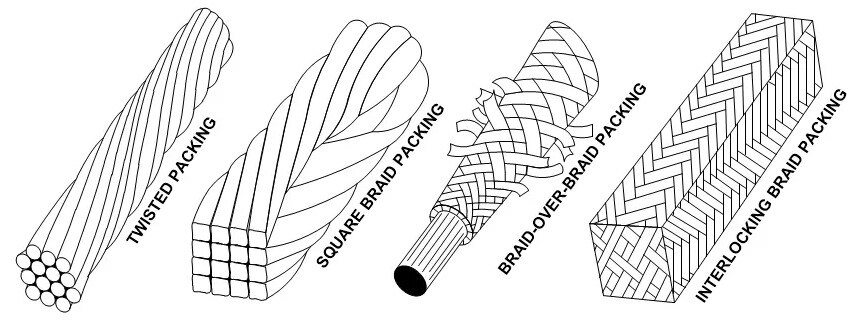
Twisted braid is the most basic form, usually made from cotton fibers twisted together and impregnated with mineral oil and graphite to improve lubrication and wear resistance. It has limited strength and moderate radial expansion capability, mainly used in light-load, low-pressure applications. Due to its simple structure and low cost, it is still used in auxiliary equipment with low sealing requirements.
Square braid is one of the most commonly used industrial packing structures. Its relatively loose weave creates small gaps between fibers, allowing significant radial expansion. When gland pressure is applied, it can expand outward sufficiently to fill enlarged clearances caused by wear.
This makes square braided packing especially suitable for aging equipment. As equipment wears, clearance between shaft sleeve and stuffing box increases. Dense packing may fail to expand adequately, while square braid can better compensate for wear-induced gaps, ensuring reliable sealing. Therefore, in pumps with large tolerances or severe wear, square braided packing is often the preferred choice.
Lattice braid, also known as interlock braid or Texlock braid, features a very tight and compact structure with minimal fiber gaps. This results in fewer leakage paths and higher sealing performance, along with improved structural stability and resistance to fraying.
However, due to its tight structure, it has lower radial expansion capability and reduced flexibility, requiring more precise installation control. It is best suited for well-maintained new equipment with high precision or applications requiring strict leakage control. If the equipment clearance is small and precision is high, lattice braid is preferred; otherwise, square braid is more appropriate.
Braid over core packing consists of an inner core layer, typically made of rubber materials such as Viton or silicone, or tightly braided fibers, wrapped with an outer braided layer. This structure is widely used in valve sealing applications.
Its major advantage is elastic recovery. Conventional packing may deform permanently under long-term compression, forming leakage channels. In contrast, elastomer-core braided packing can recover its shape after pressure release, acting like an elastic support. This makes it particularly suitable for equipment with shaft deflection or eccentric motion, such as agitators and mixers.
In high-pressure valve applications, metal wires may be added to enhance strength while the rubber core maintains elasticity, ensuring long-term sealing stability.
Braid over braid packing typically has a circular cross-section with an optional metal wire core for added strength. Multiple braided layers wrap around the core, and the structure can be impregnated with lubricants to reduce friction and improve sealing performance.
This design combines high mechanical strength with good flexibility and wear resistance, making it suitable for medium-pressure and medium-speed rotating equipment.
The performance of braided packing depends not only on structure but also heavily on material selection. Industrial packing materials have evolved from natural fibers to high-performance synthetic and composite materials.
Early packing used natural fibers such as jute, hemp, and cotton. These materials were inexpensive but had poor heat resistance and chemical resistance.
Asbestos was later widely used due to its excellent high-temperature and corrosion resistance. However, due to serious health hazards, asbestos has been gradually banned in developed countries since the 1980s and is now strictly restricted.
Modern braided packing materials mainly include:
- PTFE (Polytetrafluoroethylene): Excellent chemical inertness, strong acid/alkali resistance, very low friction coefficient; widely used in corrosive and food-grade applications.
- Aramid fiber (e.g., Kevlar): High strength and excellent wear resistance; suitable for abrasive media containing solid particles.
- Graphite and flexible graphite: Excellent high-temperature resistance, good thermal conductivity, and self-lubrication; ideal for high-temperature steam and hot oil.
- Carbon fiber: High strength, lightweight, and high-temperature resistance; suitable for high-speed rotating equipment.
- Synthetic yarns and acrylic fibers: Moderate cost and good chemical resistance; suitable for general industrial applications.
- Graphite/PTFE composites (e.g., GFO): Combine graphite’s heat resistance with PTFE’s chemical resistance; highly versatile.
In practice, material selection must consider medium properties, operating temperature, pressure range, and equipment condition. For example, using standard aramid packing in strong oxidizing acids may lead to rapid degradation and failure. Therefore, selection should always be based on technical data rather than experience alone.
Braided packing is used in almost all industries involving fluid transport and control.
In pumps, it seals the gap between pump shaft and housing to prevent leakage. It is used in centrifugal pumps, reciprocating pumps, and rotary pumps, with structure selected based on corrosion and wear conditions.
In valves, stem sealing is one of the most critical applications. Gate valves, globe valves, and ball valves all rely on stem packing for dynamic sealing, which directly affects operational safety. Valve packing must withstand high pressure and temperature, often requiring braid-over-core or metal-reinforced structures.
In agitators and mixers, significant shaft runout and eccentricity make standard packing prone to uneven wear. Elastomer-core braided packing provides better compliance and elastic recovery, significantly extending service life.
Additionally, braided packing plays a key sealing role in oil and gas extraction and transportation, chemical reactors, power boiler feed systems, wastewater treatment equipment, and pharmaceutical clean systems.
Proper selection requires comprehensive analysis of operating conditions. Key parameters include:
- Medium type: Chemical nature, acidity/alkalinity, abrasiveness, solid content, and viscosity.
- Temperature: Maximum and fluctuation range; PTFE is generally limited to ~260°C, while graphite can handle much higher temperatures.
- Pressure: Distinguish working and peak pressure; high pressure requires stronger, tighter structures and sometimes metal reinforcement.
- Shaft speed or surface velocity: High speed generates heat; requires wear-resistant and thermally conductive materials with sufficient lubrication.
- pH value: Strong acids or bases require chemically stable materials such as PTFE or graphite.
- Equipment condition: New equipment favors tight structures like lattice braid; worn equipment requires expansion-capable structures like square braid.
Incorrect selection of any parameter may lead to premature wear, hardening, leakage, or complete failure. Professional engineering consultation is recommended for critical applications.
Correct installation is essential for optimal performance.
For valve packing:
Clean shaft and stuffing box thoroughly and inspect for damage.
Cut packing rings precisely to size with a sharp tool; cut angles typically 30°–45°.
Install rings layer by layer, staggering joints by 120° to prevent leakage channels.
Install gland and ensure concentric alignment.
Tighten bolts gradually and evenly to avoid uneven compression.
Monitor initial operation; slight leakage is normal for lubrication and heat dissipation.
Adjust compression gradually to achieve optimal sealing.
During long-term operation, regular inspection is necessary. Replace packing if hardening, loss of elasticity, or excessive leakage occurs to prevent equipment damage or safety incidents.
Braided packing is manufactured and applied according to standards such as API, ASME, and ASTM, ensuring consistency and reliability.
Challenges include performance variation under extreme temperature, fatigue under pressure fluctuations, and trade-offs between initial cost and lifecycle cost. Although high-performance packing has higher upfront cost, it often provides lower maintenance frequency and longer service life.
Packing blowout is a serious safety risk caused by insufficient compression or improper selection, where high-pressure media forces packing out of the stuffing box. Proper installation and quality control are essential to prevent such incidents.
Although braided packing is a traditional sealing method, its importance in modern industry remains significant. From square braid to lattice braid, and from natural fibers to advanced composite materials, its evolution has consistently focused on higher sealing reliability, longer service life, and broader adaptability.
For engineers and procurement personnel, understanding structural differences, mastering material selection, and following correct installation procedures are fundamental to ensuring safe and efficient equipment operation. In practical applications, scientific selection based on operating conditions, and professional technical support when necessary, ensures full performance of braided packing and reliable long-term industrial operation.
