
In the operation of industrial equipment, sealing performance directly affects production safety, environmental protection, and operating costs. Under extreme conditions such as high temperature, high pressure, and strong corrosion, seal failure can result in medium leakage, equipment downtime, or even safety incidents. Traditional sealing materials often struggle to simultaneously meet the comprehensive requirements of heat resistance, pressure tolerance, and chemical stability, leading to frequent maintenance and escalating operational costs. Die-formed graphite packing rings, as precision-engineered sealing components, are produced by molding flexible graphite into uniform, dense rings using specialized die-forming processes. These rings maintain long-term, stable sealing performance even under extreme working conditions. This article provides a detailed overview of die-formed graphite packing rings, including their features, technical specifications, advantages, and selection guidelines, helping engineers and procurement professionals fully understand this critical sealing material.
Die-formed graphite packing rings are precision components specifically designed for industrial sealing applications. They are made from pure expanded flexible graphite strips. Unlike ordinary graphite rings produced through simple stamping or cutting, die-formed graphite rings are pressed into solid, uniform rings using high-hardness steel molds under extremely high pressure and controlled temperature. This manufacturing method gives the rings excellent dimensional stability, superior thermal conductivity, and remarkable durability when exposed to extreme temperatures or corrosive media.
The raw material for die-formed graphite rings is high-purity expanded graphite sheets. These sheets are placed into steel molds precisely matching the final ring dimensions and subjected to hundreds of tons of pressure under controlled conditions, forming a solid, coherent structure. In certain cases, heat is applied during the pressing process to enhance the bonding of graphite layers. Cold or hot pressing ensures rings are dimensionally accurate with smooth surfaces, and their strength and sealing properties are uniform in all directions. This isotropic performance is difficult to achieve with manually cut or spiral-wound technologies.
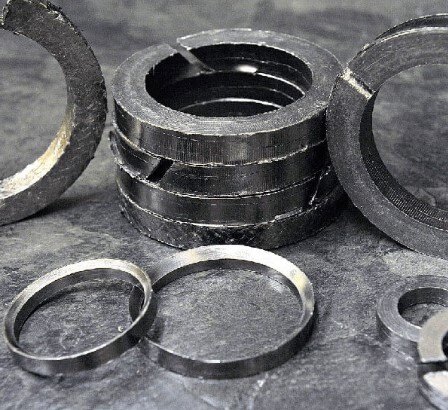
There are primarily two types of die-formed graphite rings on the market. The first type features an external positioning ring, providing additional installation support and suitable for applications where installation accuracy is critical. The second type lacks an external positioning ring, offering a simpler structure ideal for space-limited or straightforward installation conditions. These designs cater to different industrial equipment and application scenarios, providing engineers with precise and reliable sealing solutions.
Additionally, die-formed graphite rings can be customized according to specific requirements. Rings can be formed with varying density profiles through high-precision steel molds and can be provided with corrosion-resistant, anti-oxidation, or PTFE-impregnated grades. Various metal end caps can also be added to meet different specifications and operational conditions.
The exceptional performance of die-formed graphite rings in harsh industrial sealing environments is attributed to their unique characteristics, ranging from manufacturing precision and material structure to sealing capability and environmental adaptability.
The foremost feature of die-formed graphite rings is their precision manufacturing process. Pressing the graphite material into specific shapes ensures exact dimensions and tolerances, which are critical for sealing performance. Even minor deviations can result in seal failure. The die-forming process eliminates weak points or delamination, producing uniform density and grain structure and ensuring consistent radial and axial sealing performance.
Die-formed graphite rings possess a homogeneous internal structure, ensuring stable and reliable performance in sealing applications. The high purity of the material reduces the impact of impurities on sealing performance, making it suitable for a wide range of media and operating environments. High-purity graphite also minimizes corrosion risks caused by contaminants, extending the service life of the seal.
Thanks to the inherent compliance and elasticity of graphite, die-formed rings provide effective sealing even under high temperature, high pressure, and corrosive conditions. The self-lubricating nature of graphite ensures reliable operation in valves, pumps, and flanges, maintaining long-term sealing load without relaxation. This resistance to creep is a common failure point in other materials, where die-formed graphite rings excel.
Graphite's thermal stability enables die-formed rings to withstand extreme temperatures. In standard applications, they can operate within a temperature range of approximately -240°C to 430°C. In steam applications, their steam-resistant temperature reaches 650°C. Under inert atmospheres, they can even tolerate extreme temperatures up to 3000°F (around 1649°C). This broad temperature range makes them suitable for both cryogenic and high-temperature process environments.
Graphite provides excellent chemical resistance. Die-formed graphite rings can operate across a pH range of 0 to 14, offering broad-spectrum chemical corrosion resistance. They maintain structural integrity in acids, alkalis, solvents, and other harsh chemical environments, making them indispensable in chemical and petrochemical industries.
Understanding the core features of die-formed graphite rings is only the first step; selecting the right product requires attention to quantified technical specifications that determine whether the ring meets specific sealing demands. The key parameters include material and density, temperature and pressure ranges, chemical compatibility, and mechanical performance.
Die-formed graphite rings are typically made from reinforced flexible graphite, with optional anti-oxidation additives to improve durability in oxidative environments. The density range is usually 1.5–1.9 g/cm³, with higher density improving pressure resistance. Precise density control is a significant advantage of the die-forming process, allowing products to suit varying working pressures and sealing requirements.
Die-formed graphite rings cover an exceptionally wide operating temperature range. Under standard conditions, they operate from -240°C to 430°C. For high-pressure applications, metal-reinforced or end-capped models provide additional stability. In steam environments, the temperature tolerance reaches 650°C. In oxidative environments, prolonged high-temperature exposure may degrade the material; therefore, oxidation-resistant grades or additives are recommended.
With a pH range of 0 to 14, die-formed graphite rings are compatible with highly acidic to strongly alkaline environments, maintaining stability across a wide spectrum of chemical media, including sulfuric acid and caustic solutions.
Die-formed graphite rings have high compressive strength, resisting flange extrusion without deformation. Excellent thermal conductivity aids heat dissipation, preventing local overheating and potential seal failure. Additionally, these rings exhibit outstanding creep resistance, maintaining sealing load over long durations—a critical factor for reliable long-term performance.
Die-formed graphite rings stand out among sealing materials, becoming essential components in industrial sealing applications. Their advantages span general applicability, longevity, sealing efficiency, cost-effectiveness, customizability, and environmental friendliness.
Die-formed graphite rings are widely used in petrochemical, aerospace, automotive, pharmaceutical, and food processing industries. They adapt to diverse media and operating conditions, providing reliable sealing for hydrocarbons, corrosive chemicals, and high-purity systems. This versatility makes them a universal choice in industrial sealing.
These rings resist high temperatures, pressures, and strong chemical corrosion, maintaining sealing performance over extended periods. Compared to conventional packings or cut gaskets, they are less prone to failure under harsh conditions, reducing the frequency of replacements and lowering maintenance costs.
Die-formed graphite rings minimize leakage, reduce emissions, and prevent product loss, improving operational efficiency and safety. In systems handling hazardous or costly media, effective sealing translates to significant economic and safety benefits.
Despite superior performance, their long service life and low maintenance costs enhance overall system reliability. Considering the full lifecycle, die-formed graphite rings offer clear cost advantages, reducing downtime, repair costs, and potential environmental fines.
Rings can be tailored in size, shape, and performance to achieve optimal matching in various sealing applications. Special valve stem seals or gaskets requiring specific chemical resistance can be customized to meet operational needs. This flexibility allows adaptation to non-standard equipment and unique working conditions.
Graphite is a sustainable, non-toxic material, making it an eco-friendly sealing option. In an era of increasingly strict environmental regulations, using die-formed graphite rings helps reduce emissions, minimize environmental impact, and align with green manufacturing and sustainable development initiatives.
Owing to these advantages, die-formed graphite rings are widely deployed in various industrial equipment, meeting diverse sealing demands across multiple applications.
Die-formed graphite rings are commonly used in control valves, ball valves, and gate valves for stem sealing. They ensure reliable leakage control and stem lubrication, maintaining sealing integrity during long-term operation. Their reliability is particularly critical in turbine housings and high-temperature valve stems.
In centrifugal and rotary pumps, these rings prevent fluid leakage at shaft seals, ensuring operational integrity. For pumps handling corrosive or high-temperature media, the chemical inertness and thermal tolerance of graphite rings make them ideal sealing solutions.
Used in pipeline systems, pressure vessels, and heat exchangers, die-formed graphite rings maintain tight, durable seals under extreme conditions. They perform excellently in high thermal cycling areas such as heat exchanger or boiler manways and resist corrosive acids and alkalis in chemical reactor flanges.
In cylinder head gaskets, engine assemblies, compressors, and hydraulic systems, die-formed graphite rings ensure leak-free static connections. Their high compressive strength and dimensional stability prevent leakage under sustained pressure.
The robust structure and compressibility of graphite rings make them suitable for hydraulic systems, process equipment, and pneumatic cylinders under high-pressure conditions. Metal-reinforced or end-capped variants further enhance stability in extreme operational environments.
In pharmaceutical or food processing systems, die-formed graphite rings prevent contamination due to seal degradation. Their high purity and chemical inertness ensure no impurities enter the process medium, complying with strict hygiene and quality standards.
While die-formed graphite rings are highly versatile, proper selection and correct usage are essential for optimal performance. Ignoring operational conditions, improper installation, or poor storage can lead to premature failure. Guidance includes selection principles, installation tips, storage and handling, and common pitfalls.
Consider working temperature, pressure, medium type, and environmental conditions when selecting a ring. For oxidative environments, choose oxidation-resistant or additive-enhanced products. For high-pressure applications, metal-reinforced or end-capped types are recommended. Confirm chemical compatibility for specialized media.
Installation is straightforward, with pre-compression improving density and overall performance. Ensure sealing surfaces are clean and flat, avoiding surface damage. For rings with external positioning, correct placement is crucial for sealing accuracy.
Store rings in original packaging in a clean, dry environment, avoiding moisture, contamination, direct sunlight, and UV exposure. Prevent contact with water or chemicals to avoid degradation. Handle with care to prevent damage or deformation, preserving sealing performance and lifespan.
A frequent mistake in industry is using general-purpose seals in harsh applications. Ordinary packings or cut gaskets often fail under combined stress from high temperature, pressure, and corrosive media. Die-formed graphite rings are specifically designed for these conditions, with uniform density and grain structure. Unlike spiral-wound gaskets, die-formed rings contain no potentially corrosive metal winding, ensuring superior durability in aggressive environments.
Die-formed graphite packing rings, with their precision manufacturing, high purity, and excellent sealing performance, play a critical role in industrial sealing. Whether in valves, pumps, flanges, or static connections, these rings ensure reliable leakage control and equipment integrity. Their broad temperature range, outstanding chemical resistance, long service life, and cost-effectiveness make them indispensable in modern engineering systems.
For procurement and maintenance professionals, understanding the manufacturing process and technical specifications of die-formed graphite rings is vital for specifying the right seal and avoiding costly downtime. By selecting the appropriate graphite grade and matching operational conditions, die-formed graphite rings deliver exceptional performance and reliability across diverse industrial applications. In petrochemical, chemical, pharmaceutical, food, and energy industries, they guarantee sealing integrity and long-term operational stability, making them essential components in critical equipment.
