
In modern industrial equipment, sealing technology is a crucial aspect for ensuring the safety, stability, and efficient operation of mechanical systems. Packing, as the most common type of sealing material, is widely used in pumps, valves, compressors, and various rotating or reciprocating shafts due to its simple structure, low cost, and strong adaptability. Understanding the basic concepts, working principles, material characteristics, and application scenarios of packing is essential for engineers and maintenance personnel in equipment selection, operational optimization, and maintenance management. This article systematically introduces the types, performance, selection, installation, and maintenance methods of packing, providing a comprehensive reference for industrial sealing.
Packing, also called sealing material, is a substance used for mechanical sealing. It is usually made of soft, thread-like fibers woven together, with a variety of cross-sectional shapes such as triangular, square, rectangular, and circular. These strips are filled into the sealing cavity and compressed to achieve the sealing effect. The earliest packing seals used cotton, hemp, or other fibers inserted into leakage paths to prevent fluid escape. This sealing method was simple and easy to implement. The raw materials were widely available, easy to process, cost-effective, and provided relatively reliable sealing performance. It was also simple to operate, which is why it has continued to be used to this day.
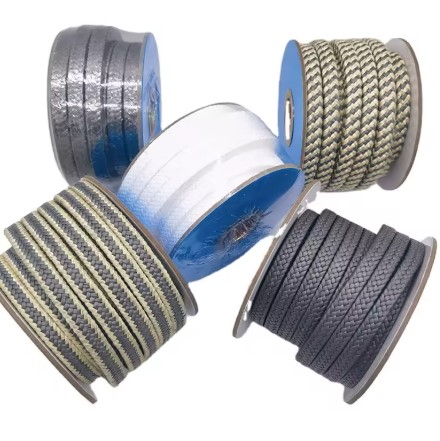
Packing has extremely wide applications. It is used for shaft sealing in centrifugal pumps, compressors, vacuum pumps, agitators, and ship propellers, as well as for reciprocating shafts in piston pumps, reciprocating compressors, and refrigeration machines, and for rotational sealing in various valve stems. These devices play an important role in industrial production, and the sealing performance of packing directly affects the operational efficiency and safety of these devices.
The working principle of packing is not complicated. The surface of the shaft is microscopically uneven, and the packing can only partially contact the shaft. This creates small gaps between the packing and the shaft, forming a labyrinth-like structure. When the medium passes through these gaps, it is repeatedly throttled, achieving a sealing effect. The packing is installed in a stuffing box and compressed against the shaft surface by a gland. Because the shaft surface is somewhat rough, the packing only partially contacts the shaft, forming countless maze-like paths. When pressurized medium flows along the shaft surface, it is repeatedly throttled, and this “labyrinth effect” achieves the sealing.
In addition to the labyrinth effect, the contact and friction between the packing and the shaft surface resemble a sliding bearing. Therefore, packing requires sufficient lubrication to ensure a certain service life, which is called the “bearing effect.” A good packing seal is a combination of the labyrinth effect and the bearing effect. The axial compression force on the packing is generated by tightening the gland bolts. Because packing is an elastic-plastic material, when axially compressed, it generates friction, causing the compressive force to gradually decrease along the shaft. Simultaneously, the radial compressive force presses the packing tightly against the shaft surface, preventing medium leakage. The distribution of radial compressive force decreases sharply from the outer end (gland) to the inner end and then gradually levels off, while the distribution of medium pressure gradually decreases from the inner end toward the outer end. When the medium pressure at the outer end is zero, leakage is minimal; when it exceeds zero, leakage occurs.
As a sealing material, packing must have certain characteristics. First, it should have elastic-plastic properties. When axially compressed, the packing should generate sufficient radial compressive force to achieve sealing. At the same time, when the machine and shaft experience vibration, runout, or eccentricity, the packing should have a certain compensating ability, known as followability. Second, packing must have chemical stability. It should not be corroded or swollen by the medium, nor contaminate the medium. Furthermore, packing should be impermeable. Although most fibers have some permeability to medium, the packing structure must be dense. Therefore, during manufacturing, packing is usually impregnated and filled with various lubricants and fillers. Packing should also have good self-lubrication, low friction coefficient, and wear resistance. Additionally, it must withstand a certain temperature, maintaining performance even when friction generates heat. Of course, packing should be easy to disassemble, simple to manufacture, and low-cost.
With the continuous emergence of new materials, the structural forms of packing have changed significantly. Currently, packing can be classified as follows:
Natural fiber packing mainly uses materials like cotton, hemp, and wool as the sealing base. These materials are widely available and low-cost but have relatively limited performance.
Mineral fiber packing mainly includes asbestos-based packing. Asbestos packing has good heat resistance and chemical stability. However, asbestos is harmful to humans, so its use has gradually been restricted in some countries and regions.
Synthetic fiber packing includes graphite, carbon fiber, PTFE, Kevlar, acrylic-silicone fiber, and other types. The packing has different performance characteristics suitable for various operating conditions. For example: graphite packing has good self-lubrication and high-temperature resistance; carbon fiber packing has high strength and wear resistance; PTFE packing has good chemical stability and corrosion resistance; Kevlar packing has excellent elasticity and chemical resistance; acrylic-silicone fiber packing has good sealing and lubrication performance.
Ceramic and metal fiber packing includes silicon carbide, boron carbide, and alkali-resistant glass fiber types. The packing usually has higher strength and high-temperature resistance, suitable for special operating conditions.
Because single fiber materials have some disadvantages, using single-fiber woven packing may leave gaps between fibers, easily causing leakage. Additionally, some fibers have poor self-lubrication and high friction coefficients. Therefore, packing is often impregnated with lubricants, fillers, and special additives to improve density and lubrication. Examples include mineral oils mixed with graphite powder or molybdenum disulfide grease, talc, mica, glycerin, vegetable oils, or PTFE dispersion emulsions with surfactants and dispersants. Special additives include zinc microparticles, barrier agents, and molybdenum-based corrosion inhibitors, which reduce packing corrosion on equipment.
Next, we will explore some common packing types and their performance characteristics. The packing plays an important role in various industrial applications. Understanding their features can help select the most suitable packing to meet specific sealing requirements.
Aramid packing includes golden aramid fiber, yellow aramid fiber, aramid fiber interwoven with white PTFE, and aramid fiber interwoven with black PTFE. The packing uses aramid fibers as the main material, repeatedly impregnated with lubricants, PTFE emulsion, and precisely woven. They have good resilience, chemical resistance, low cold flow, and high line-speed tolerance. Compared with other packing, they resist particulate media and higher temperatures. They can be used alone or combined with other packing, mainly for abrasive or particulate media conditions.
Includes white PTFE, black PTFE, PTFE interwoven with aramid fibers, pre-oxidized PTFE, PTFE impregnated with silicone oil, and PTFE core-impregnated packing. Made of PTFE as the main material, it has excellent chemical stability, corrosion resistance, sealing, high lubrication, non-stick properties, and aging resistance. Can operate long-term from -180°C to +250°C. Except for molten sodium and liquid fluorine, it resists all chemicals and does not change in boiling aqua regia. Mainly used where contamination is not allowed, such as sanitary or highly corrosive environments with high line speed and wear.
Includes flexible graphite, metal-reinforced graphite, carbon fiber-reinforced graphite, and carbon fiber-metal-reinforced graphite. Made of graphite, finely woven. It has excellent self-lubrication, thermal conductivity, low friction, versatility, softness, strength, and shaft protection. Can be reinforced with carbon fiber, copper wire, 304/316L stainless steel, or Inconel wire. Mainly for high-temperature and high-pressure conditions.
Includes carbon fiber-reinforced graphite and carbon fiber-metal-reinforced graphite. Uses carbon fiber as the main material. Carbon fiber has excellent mechanical properties, no creep, good fatigue resistance, low thermal expansion, corrosion resistance, and good heat conduction. Used in high-temperature, high-pressure, and wear-resistant conditions.
High-quality acrylic fibers, pretreated with PTFE emulsion and woven in square patterns, fully impregnated again during weaving. Provides dense structure, high strength, and lubrication. Multi-purpose, widely used in pumps and valves, suitable for most chemical media except strong acids, strong alkalis, and strong oxidizers. Especially suitable for medium temperature, high pressure, high speed, and contamination-sensitive conditions.
Selecting appropriate packing is critical to equipment sealing performance. Factors include medium properties, temperature, pressure, line speed, operating conditions, and cost. Examples:
Sanitary applications: PTFE or golden aramid packing.
High temperature and pressure: Graphite or carbon fiber packing.
Abrasive media: Aramid packing.
Vibration absorption and leakage control: Elastomer-core packing.
Cost-effectiveness should also be considered, selecting the most economical packing while meeting operational requirements.
Proper installation and maintenance are key to sealing performance:
Ensure stuffing box and shaft surfaces are clean.
Cut and install packing according to type and operating conditions.
Avoid over-compression to prevent damage or shaft wear.
Ensure tight joints to prevent leakage.
Inspect regularly; replace worn packing promptly.
Lubricate where required to maintain performance and longevity.
Overall, packing is a mature and reliable mechanical sealing material. With diverse materials and structures, it meets sealing requirements under various industrial conditions. From natural fibers to high-performance synthetics, from conventional shaft sealing to high-temperature and high-pressure applications, packing plays a vital role in ensuring equipment safety and extending service life. Proper selection, installation, and scientific maintenance are key to stable sealing performance. With the development of new materials and processes, packing has an even broader application prospect, providing continuous and reliable sealing for modern industrial systems.
